Welcome to Painted Hand Farm

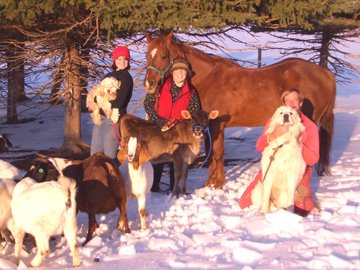
Painted Hand Farm is a 20 acre Civil War era farm located in Cumberland county, Pennsylvania. We raise meat goats, veal calves, turkeys and organic vegetables using humane and sustainable agricultural practices.

Search This Blog

Sunday, November 12, 2006

Fall Fare

I love fall. Maybe I should clarify that statement. I love eating in the fall. The early frosts bring out the sweetness in the chards, kales and brussel sprouts. The vines on the all the potatoes die back signalling their readiness to be dug from the earth softened by autumn rains.

Digging veggies liberates that earthy aroma--the familiar fragrance mixed of mineral, decaying organic material and the vegetables themselves. I love the way the dirt clings to my fingers as I snap the sun chokes off the root ball that once supported sunflower-like stems towering over six feet. "Choke" is an appropriate name for them since they literally choke out everything in the surrounding area. Right now the horseradish is fighting for its patch in the perenial garden and the noduled tubers are encroaching into the herbal district.

Another aspect of fall is with the cooler weather comes butcher time. A few weeks ago, we had to slaughter a goat for roasting at a picnic so at the same time, we did a lamb for the freezer. Ralph was going out of town, Jessica was going to a friend's for the weekend so I vacuume-packed all of it until tonight.

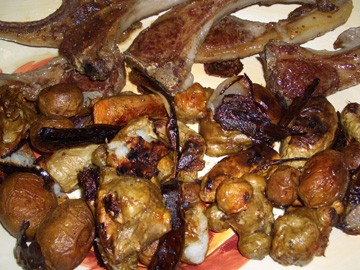
It feels really good knowing that only an hour earlier the roasted sweet potatoes and russets, sun chokes, onions and carrots on our dinner plates were still snug in the garden and the lamb chops led a bucolic life in pasture prior to a quick and humane dispatch. I rest easier knowing that lamb was slaughtered and packaged in a clean environment...my backyard and my kitchen. My vegetables have been fertilized with rich compost made from the manure of grass-fed animals...no O157 E. coli on my salad greens.

Raising healthful, natural and safe food for ourself and others is a lot of hard work, but when I am able to sit down to a meal, such as tonight's, it puts a season of our labors into perspective.

Tuesday, November 07, 2006

Farming with Free Stuff Revisited


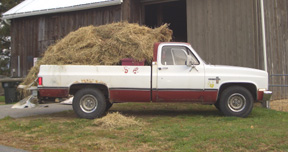
It's one thing to salvage things like sheds, vehicles, tools, etc., but the opportunity recently presented itself for a roadside salvage operation for some premium hay.
"Sandy, someone dropped a large bale of nice hay down the road from your place," said the voice of my ususal hay man on my answering machine, "It's laying right along side the road." With over a hundred mouths to feed on the farm, this warranted a closer look so I grabbed a pitchfork and corralled my daughter into going along.
Sure enough, there was a very large bale of number one hay pushed off the road on a curve. It was hay auction day, so my guess is one of the local farmers took the curve a bit too fast and the bale fell off breaking open. I positioned the truck on the downhill as close to the hay as I could get and began loading it on the truck.
"Mom, this is so embarassing. What if someone from school sees us?" my daughter wailed.
"Tell them that because I got $50 of free hay, I can spend that on clothes for you," I shot back and then went on to ask her how much the dress was I had purchased for her a few weeks before.
"There's no way you're going to fit all of this on the truck," she countered.
"Watch me." For the next fifteen minutes we proceeded to stack all of the 750 pound bale on the truck. She needled me again.
"We'll never get it all home." In response, the truck never reached 10mph on the trip up the street. Not only did I get the entire bale on the truck, I made it home without losing any.
The next day I got a call from one of the other local farmers from whom I often purchase hay.
"You must be really in need of hay if you have to pick up what I've dropped along side the road," he joked. Actually, he admitted to yes, as I suspected, taking the curve too fast on his way to the hay auction and losing, not one, but six large bales off his truck. Fortunate for him, only one broke open.
Since he was scheduling a delivery I offered to pay him for the bale. "Nah, that was close to an 800-pound bale. If you picked it up, you earned it," he said.
So for 15 minutes of exercise, I made off with $50 of premium hay. Not too shabby.

Thursday, November 02, 2006

Gobble Gobble


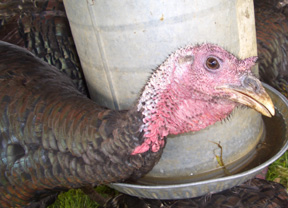
I raise a flock of Heritage turkeys on pasture each year because I like the taste of grass-fed poultry and I want to make sure the bird that graces my holiday table hasn't been stuffed in some fetid commercial poultry house breathing fecal fumes and been subjected to the mutilation of having its beak and toes chopped off to prevent the cannibalism that is commonplace in overpopulated poultry operations. The first year we moved to the farm in Pennsylvania, we bought poults from a local Mennonite family with a large turkey operation. They only had half a top beak and the scarred toes left alien prints in the dirt as their toes looked more like geko feet than that of a turkey.

So what's the big difference between a Heritage and a Commercial turkey is the most common question I'm asked and I always answer breasts & sex. Modern birds are the Dolly Partons of the turkey world. They've been selectively bred to grow gargantuan pectorals to please consumers. Unfortunately, at the same time, they've bred the ability for these top-heavy gobblers to reproduce naturally. We allowed four of our Mennonite-mutilated birds to reach adulthood--three hens and a tom. When spring came, the hens lined up ready to be services but the poor ol' tom could only give them some "wing". With his enormous chest, his tiny pecker (and I'm not talking about the half a pecker on his face) couldn't come close to hitting the mark. So we ate the turkey eggs along with the turkeys eventually.

Which leads me to the next most common question--how can you eat your turkeys? That's easy. Anyone who has ever raised turkeys will tell you that by the first of November they start chanting, "Three more weeks! Three more weeks!" I move two dozen birds in a portable house two to three times a day and by now the amount of crap they leave behind will gag even the strong of stomach. I can only imagine what thousands of these critters confined by the thousands in an enclosed building must be like.

I've also read enough USDA butchering regulations to know that the reason the health department suggests you incinerate a turkey to 180 degrees internal temperature is because of all the unsanitary conditions when the birds are processed. When anyone eats one of my birds, I've personally cleaned it and know that the intestinal tract hasn't been broken open by automated cleaning equipment thus contaminating the carcass with fecal matter--the source for pathogens that make people sick.

But there is one thing about my Heritage turkeys that I do love (beside the taste). There's something ethereal about stepping outside on a crisp autumn morning and hearing turkeys. They chirp and tribble some while young, but the familar gobbling doesn't begin until mid-October when the first frost appears against the backdrop of flame-colored leaves signalling fall.


Tuesday, September 05, 2006

5th Annual Labor Day Goat Roast

Yes folks, we survived yet another goat roast here on the farm. Over sixty of our family and friends turned out to wind down summer and share the fruits, vegetables, meats and dairy products of our labors. That's Ian Dietrich and Mark Cochran slicing up the roasted goat. There was also BBQ pulled pork and smoked turkey for those not brave enough to partake in the most widely-consumed meat on this planet. Believe it or not, more people eat goat meat than beef, pork, fish, poultry and game.

This year we went island-style instead of Mexican. The goat was rubbed with Jamaican jerk spiced, stuffed with chunks of fresh pineapple, papaya, oranges and cilantro and roasted on a spit over hot coals while basted with crushe pineapple, orange juice, crushed garlic and olive oil. The result was stunning. Out of a 40-pound goat, we had a one-quart container of leftovers.


The assortment of goodies laid out on the buffet table was overwhelming, but my all-time favorite is the home-made ice cream. For the last few years, we always did fresh peach with goat's milk, but sadly this year our wonderful milk goat, Liberty passed away. Breaking from tradition, I procured a few gallons of very fresh, whole Jersey milk. First, I let the luscious thick cream float to the top and then skimmed it for later use. The 'skimmed' milk was mixed with fresh pastured poultry eggs and turned into a custard. When the time was right, I put the custard, fresh cream and a thick syrup made from reduced wild black rasperberry juice and sugar all into a White Mountain Ice Cream Maker and plugged it in. In 20 minutes, we were treated to the most incredible, berry-flavored, silky home made ice cream I've ever done. I made sure everyone got a scoop, but I got my favorite part--to lick off the beaters!

As requested by several folks, here is the ice cream recipe.

Wild Black Raspberry Ice Cream

1/2 gallon whole milk (use creamline if you can get it)
1 pint fresh cream
4 large fresh eggs
1/2 vanilla bean, scraped
2 cups raw sugar
1 pound black raspberries

Custard
Beat 1 cup milk and eggs on high until fully mixed and frothy. Put into a heavy-bottomed pot with the remaining milk, 1 cup sugar and vanilla bean scrapings. Slowing bring to a light boil while whisking constantly. Cook 3-5 minutes until it starts to thicken. Remove from heat and continue to stir for 3-5 minutes. Let cool further, transfer to container and refridgerate.

Berry Syrup
Puree berries in a food processor until mushy. Drain in cheese cloth so there is only juice--no seeds. Squeeze as much juice as possible and discard solids. Tranfer juice to sauce pan and reduce by 1/3. Add sugar, bring to a boil for 2-3 minutes. Cool and refridgerate.

Making the Ice Cream
In a six-quart ice cream maker, put in custard, berry syrup and cream and make according to manufacturers' instructions.


Friday, September 01, 2006

It's raining....

Ok, so I rarely post. Think of it as a mechanic whose car needs fixed, a plumber with a stopped up toilet, a seamstress with hems too long, a hair stylist who needs her roots covered....you get the picture. But here I sit with Ernesto bearing down on us, a chicken in the oven, okra waiting to be fried and me killing time until Jess gets home from work. Ralph is happy on the couch with all the pets camped out on top of him.

As the rain finally arrives after a most dry summer, I thought I'd share the latest of farm gadgets (pardon the lack of pictures). After five years, we finally had rain gutters installed on the barn. Not wanting to squander all that wonderful rain we had been dancing for, we plumbed the downspouts into a stock tank to capture the runoff. Our 100-gallon Rubbermaid said idle for several weeks until we were blessed with 3/10th of an inch of rain last week. Starting out dry, the tank was millimeters from overflowing when the rain stopped. So we can officially say that 3/10" rain on half our barn roof yields 100 gallons.

Recently I was awarded a Project Grass Grant to increase the fencing on my farm for rotational grazing and the big question was how I was going to provide water to my stock. So I put Ralph to work with his creative ways. For those of you who remember the stories of the fish boxes, they are having yet another iteration. He plumbed the 100-gallon tank at the barn with a ball-valve leading into a collapsable irrigation pipe (which he had to encase in PVC & drainage pipe to keep the more gregarious critters from playing with it) and down over the hill (gravity feed) into the famous fish box. If you've ever watched any of the newer Star Trek series, you'll recognize them as a staples of the cargo decks. They are 300-gallon poly-boxes that can be picked up with a fork-lift and they have flat lids that snap on so they can be stacked.

This particular fish box had functioned as our quasi-hot tub for many years out west (and for a while here) before being plumbed up for a water storage tank.

We've had about a half inch so far and the system is working well. Water falls from the sky, hits the barn roof, is gathered by the gutter and directed downspout to the 100 gallon tank. When it reaches capacity, water then flows through the irrigation pipe approximately 300 feet down hill to the fish box tank where it has a hose fitting to supply water to assorted water barrels for the goaty girls.

And when Mother Nature doesn't deliver, there is always the well.

Sunday, April 02, 2006

BEEF--It's what's in the barnyard.


Last week when I was driving back from Penn State with a fellow farming friend who owns a dairy, I asked about getting a bull calf to raise up as a beef steer.

"Oh please! How many do you want? I'm overrun with bull calves right now," she said.

The possibility of plural sent warning bells since the only time we acquire more than two of anything at a single time on the farm is with fowl.

With that thought passing through my mind I replied, "One or two would be fine."

"How about three," she countered.

"Sure. I'll pick them up on Saturday." What had I gotten myself into?

Saturday rolled around and when I went to pick up the calves, there was Mel's husband with halters on FOUR calves.

"Four calves?" I asked.

"Mel said you were to get four," he replied. Looking over at her calf hutches, I saw why. There was no room left at the inn and some pens were doubled up with smaller calves.

So home I went with four bull calves.

Now many people who raise animals for meat don't name them, but my philosophy has always been to know the name of everything in my freezer. I know where it came from, how it was raised, how it was slaughtered and that it hasn't been pumped full of antibiotics, synthetic estrogen (growth hormones) and carbon monoxide to keep it looking fresh well after it has rotted.

Meet Pinky, Blacky (the colors of their tongues), Blondy and Dameon (he was born on 6-6-06).

Oh sure, feeding cute calves with a bottle...right? I DARE anyone to walk into a group of hungry calves with one bottle. They may be babies, but they are 100 pound babies with these tiny nubs growing out of their skulls that leave colorful bruises on your legs when they butt you with their heads (common action used to massage the cow's udder to stimulate milk let down). They may only have teeth on their bottom jaw, but they will still take the skin off your knuckles when they try to suck on your fingers thinking they're going to get something. And if you're not paying attention and your clothing gets chewed on (they have teeth in the back) it can be literally shredded in a matter of minutes.

So the next step was to put together something called a "mommy bucket". Two buckets with two teats each for four calves worked like a charm.

Friday, February 17, 2006

Farming with Free Stuff

I recently wrote a story for New Farm about turning a junk farm into a functioning sustainable enterprise. When the editor asked me to talk about the financial costs, it got me thinking more about the savings we've done by salvaging, recycling and trading in order to get where we are.

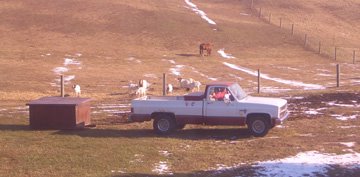
Yesterday, I took this picture of Ralph moving a portable goat shed. As I looked closely at it, it spoke the world as to how people can effectively farm without spending a fortune.

This picture represents a savings of approximately $34,000. Yes, that's right...thirty-four thousand dollars. This is the list of all the items in that picture that only cost us our time.
  • 68 fence posts removed from a neighbor's property who no longer wanted fencing. We knew the fence had been installed less than five years prior by the previous owner. The posts are 6" treated which cost approximately $8.50 each new.
  • The portable shelter is made out of a shipping crate for a large network attached storage device that was delivered to the lab were I used to work. The guys were going to dismantle it until I had them load it in the back of my truck. The crate made two sheds. The sheds are covered with aluminum from an above-ground pool that has a fake wood graphic. Ralph picked it up along side the road during large trash item clean-up week. The skids are from landscaping timbers my uncle was hauling to the dump. He just happened to stop by to say hello before going. Needless to say, his load was significantly lightened. New Port-a-Huts with the same space are $475 each. In addition to being portable, our huts can be set face-to-face 31 inches apart and then a rubber roof (scrap from our neighbor's roofing business) covered garage door (also salvaged from a neighbor's remodel) can be set over the span creating an even larger hut.
  • The pure-bred Boer buck that has bred 21 of my does was leased in trade for my work for the owner to create a 36-page catalog for their production pen sale. If I were to purchase a buck of this quality, I'd spend a minimum of $2,500.
  • And for the biggest savings of all...the truck. Yes, that truck was free! I have the exact same year and body-style truck in a diesel version so when a former co-worker of mine was moving out-of-state and wanted to get rid of his old truck, he offered to give it to me for parts. It ran rough and had over 250,000 miles on the engine, but lots of the parts were still good. We drove it home and after $78 in parts, the truck ran fine. That was nearly three years ago and we've put less than $100 in it since. Even the tool box in the bed was free. Granted, it took some sanding and painting to make it look better, but both gull-wing doors work fine and it doesn't leak. A new Chevy today would be around $30,000.
As you can see, there is a significant savings to be had by not being afraid to do a little dumpster-diving, spending time removing something useful someone else doesn't want and trading your non-farm expertise for goods & services.

Be creative! We salvaged an entire farm! This place was a dump when we first arrived in 2000. I could add even more ideas--kidding pens from old doors (they even match!), shelters from silo covers on pallets. Look around...there is lots of life left in what others call "junk". Ralph built a cold frame out of another neighbor's garage doors. It's the middle of February and we are still eating fresh salad!

It's taken a lot of sweat, but we're meeting our goals. Yes, I don't have all the latest and greatest status-symbol items. But I also don't have any consumer debt or a vehicle payment. So for anyone who says they can't afford to farm, I say HOGWASH!

Wednesday, February 15, 2006

BABIES!!!!

Everyone has been after me to keep up with my farm blog, but writing for a living....well, you know it's like a plumber with leaky pipes and a mechanic whose car always needs fixing. But the babies are coming daily so I thought I'd post a little something every day during kidding season.

Kidding season officially started last Friday with a set of twins born to a purebred Boer doe--Clara. She's a lousy mother...never even looked back at her kids. Left them there on their own. I had to halter her to nurse.

Two days later, we had another terrible mother--Ashley--with twin bucks. Jessica joked that we should name one of them "Karen" (after her biological mother), but then changed her mind deciding to save that name for a future market hog.

Nestle also kidded that evening, however, she was a wonderful mother to her single doe.

The next day held our first casualty. Pumpkin Pie had trouble kidding and drug her partially born baby around essentially killing it before it was born. In an attempt to salvage her colostrum (first milk, for you non-farming folk), I haltered her and worked at grafting one of Ashley's kids on to her.

Teacup, also a maiden doe, popped on the 13th with a big buck.

February 14th brought us two maiden does each kidding large singles. Appropriately, the girl was named Valentine and the boy is Cupid. Cupid is a toad and will most likely be one of Jessica's 4-H projects (that's Cupid and his mother, Oreo).

So far, all of the kids have been white with brown heads....traditional Boer, regardless of their percentages. But this afternoon Anabelle graced us with our first two paint kids. The doe has a dark brown body with two white legs on the left side. Maybe I'll name her Lefty. The second kid born was a traditional colored buck and a few minutes ago she surprised us with a triplet buck all dark brow with a lightening bolt down his ribs on either side...flashy little devil!

Monday, January 02, 2006

Hello 2006

It's hard to believe twenty-oh-six is already here--seems like only yesterday that we were loading up the rig and heading east (in 2000). We've had Jessica back in our lives for just over a year now, too. The goat herd is growing, we've added a calf, (yes, Tibet is still here, but she's camera shy) and we've added another pasture. As a resolution, I'm going to try to keep the farm's blog better updated. There is lots coming up...PA State Farm Show, Pennsylvania Association for Sustainable Agriculture's annual Farming for the Future Conference, kidding season, new laying hens and a fresh batch of turkeys. Stay tuned.

Monday, August 02, 2004

The Story of Tibet

Be Careful What You Wish For
You Just Might Get It!


This is the story of how I acquired a Yak whom I named Tibet. Follow along in my adventures of my new farming venture.

As a fledgling farmer, I joined a sustainable agriculture organization that was pretty active at the local level. There were veggie growers, fruit growers, flower growers, dairy owners, cheese makers, poultry producers, beef ranchers, fiber people with sheep, llamas, alpacas and then there was me—the meat goat farmer.

“I’m not milking no goats,” bellowed my dearly beloved each time I would state my desire to become a goat farmer in the early days of our relationship. The years went by and so did a steady stream of meat rabbits, turkeys, laying hens and pheasants. Renting kept the animal population reined in. Finally, to mark the turn of the millennium, we bought a Civil War era farm across the country, sight unseen, loaded up my horse, two dogs, a cat and my sweetie. Off we went to find bliss on our own patch of ground.

Granted, the animal residents didn’t come immediately since there was no fencing and the farm was in serious disrepair. I did manage to get a late spring start on a flock of laying hens and a few turkeys, though. They lived in an old tin shed from Sears the previous owner had left until we had a fenced-in barnyard in which to turn them loose. We added rabbits to the mix, but found they didn’t breed year-round as they had in the west. We pondered a hardier type of livestock. Goats were my answer, but my love’s reply was still the same, “I’m not milking no goats.”

It turned out that meat goat production was on the rise in the country. Evidently, to supply the demand for ethnic people, the United States was importing hundreds of thousands of meat goats a year. Raising them didn’t involve a serious outlay of cash as many of the exotic livestock pyramid schemes often did. So off we went to purchase our first two goats.

Within two years, two goats turned into twenty-two and we began selling the male kids for meat. Our customers were Italians, Moroccans, Bulgarians, Mexicans and Jamaicans. We had an instant market and were pleased with the way the farm was coming along.

Although the goats were specifically raised for meat, that first year after the two does freshened and the kids were weaned I tried my hand at milking. Sweetie built a milking stanchion for me and I bought myself a stainless-steel milking pail. But no one ever told me that goats need to get used to being milked.

That first week, every night I would come home from the office and spend the next hour trying to milk two goats that didn’t want to be milked. I got stepped on, kicked, covered with manure as well as milk when they would rear up and plunk their feet down right into my nice clean stainless steel bucket that had what little milk I had already stripped from their teats. My hands got sore. Milking is repetitive and unlike tapping on a keyboard all day, required a little more finesse.

The second week went much better as both the does and myself were getting used to the daily routine. With a couple gallons of fresh goat milk I decided to try my hand at making cheese. And what wonderful cheese it was. I was hooked.

Articles about ‘artisan cheeses’ started showing up in the food section of the New York Times, Food & Wine, Gourmet magazine and Bon Appetite. Dairies were adding creameries to their operation for value-added products which helped the family farm once again become sustainable. I began experimenting with different cheeses.

By the next freshening season, I had increased my herd and was now milking six goats, four of which were first time milkers. Once again I went through the challenge of getting a routine going. Fortunately, a local goat farmer who had switched from milk to meat goats offered to give me his old surge milker. After learning the difference between a vacuum compressor and an air compressor, we got the surge milker operational and milking six goats went from being an hour affair to less than 15 minutes. This was a snap. Unfortunately, my meat goats didn’t provide the quantity of milk I was hoping for and I began to scheme for a way to increase the amount of white liquid I coveted.

The original plan soon hatched after selling a market wether to a 4H kid. “The 4H Roundup in August 4,” she told me. Perfect. That was my birthday and because we would be at the auction watching our first 4H project, it would be the perfect time to purchase a nice fresh dairy goat that would provide at least a gallon, instead of only a quart each day. I had it all figured out, only August was months away.

During this time, while attending a PASA meeting, I met Melanie Dietrich-Cochran of Keswick Creamery. She lived a few miles away, had grown up in a dairy family and even had a college education in dairy sciences from one of the best agricultural colleges in the east. I picked her brain every opportunity I got. And then one day she asked, “Do you know about the one-cow exemption?” By the look on my face, she must have known I had absolutely no idea what she was talking about. “You can sell all the cheese you make from one cow without having to be inspected and licensed,” she informed me. Bingo.

The next question was what type of cow to get. I did my homework and decided to purchase a Brown Swiss due to the volume of milk they produced. However, during my research, one particular statistic caught my eye. Yak’s milk had a butterfat content of 6-9 percent compared to the 2-4 percent of cow’s milk. That would mean since I got roughly a pound of cheese out of a gallon of milk I begged off from the local farmers, that a gallon of yak milk would double my yield.

Just for the fun of it, I researched yaks. My dream didn’t last long due to the facts that most yak ranches were in the west and the ones in the east weren’t anywhere near us. Add to that they were out of my price range and I was back at the Brown Swiss before long. But my interest in the yaks had been piqued.

Although they are bovids and can be bred to regular dairy bulls, they have a hump and horns like buffalo and shed a cashmere-grade downy fiber that is highly sought after by custom spinners and weavers. Their meat is lean like buffalo, but they do not require Fort Knox fencing to keep them contained. But the big selling point for me was their efficiency for converting forage into muscle. It takes twelve pounds of forage to gain a pound of meat in a cow, sixteen for a buffalo, but only six for a yak. The statistics were great, but my logistics were not. So I started looking for a Brown Swiss.
Another PASA meeting rolled around and this time I met a local spinner/weaver who raised wool sheep, angora goats, llamas and alpacas. During our conversation, I casually said that if she ever came across a yak for sale in any of her fiber circles, I would be interested. Little did I know that she would email me less than twenty-four hours later with news there was a yearling yak heifer less than two hours away and the price was in my budget. Looking at her message, I sat there dumbfounded. “Be careful what you wish for, you just might get it,” has been a favorite manta of mine over the years and once again those words rang true.

I contacted the yak seller and found out that they had acquired the yak as a weanling. She had been kept with a herd of Scottish Highland cattle. While the gentleman had his dreams of one day having a whole herd of yaks, his wife did not share his vision. The yak had to go.

Now I still commute to a high-tech job everyday despite my hankering for farm life. Since the yak wasn’t far from my office, I decided I would drive out on my lunch hour one day and check her out. But then I got to thinking….

Why waste a trip out there just to look at her without taking along my stock trailer. If she’s healthy and I buy her, why not just load her up and take her along home. With the price of fuel these days, cutting down on driving was always at the forefront of my mind.

On a Friday morning before heading to work I asked my honey if he would help me hook up the trailer. “Why? I thought you were just going to look at the yak,” he said. At that moment, he knew that unless the yak only had three legs or was deathly ill, it would be coming home with me.

At the office, my co-workers questioned the trailer in tow. I casually told them at lunch I was going to look at a cow. I didn’t use the word ‘yak’. While everyone else went off for tacos and burgers, I was on my way to fulfill yet another dream.

When I arrived at the farm a swarm of pigmy goat kids greeting me before a lanky gent emerged from the barn. We made our introductions and he took me inside to where the yak was tied to a post. She was much smaller than I expected, maybe twelve hands. Her horns and head appeared disproportionate to the rest of her body. And that tail! It was snow white and full like a horse’s tail. I approached her and began to pet her. Whoosh! Up came a hind leg with lightening speed hoping to connect. Fortunately, I was not in her range of motion.

“Be careful there, she’s pretty wild,” said the owner. She had been in pasture with his herd of Highland cattle and hadn’t been handled at all. Yes, she was wild alright.

Fortunately, she stood well enough I could run my hands over her ribs and check her eyes and gums for anemia—a sure sign of a heavy worm load. She was lean, but well muscled and all her membranes appeared pink and healthy. “I’ll take her.”

Once we had settled up, I backed my trailer up to the doorway that was flush with the alleyway. The owner had called his Mennonite neighbor who soon arrived with his three young sons. I could tell by the way the Mennonite looked at me that he thought I was some kind of kook to be buying this wild, big-horned critter. Both men held firm on each horn while the oldest son untied the yak from the post. The men drug her down the alley and hoisted her front end into the trailer. She gladly hopped in the rest of the way and they shut the door. I now had the yak in my possession and back down the road I went.

The ride back to the office was uneventful. Upon my return it only took for one co-worker to say the word, ‘yak’ and everyone else was off to check her out. She was content to sit in her bedding and munch away on hay until the end of the day.

Home we went. Sweetie was mowing the lawn when I pulled in the driveway. Knowing that I’d need to be doing some serious taming, I opted to turn her out into the large paddock area next to the barn. I pulled the truck into the paddock, turned around and pulled out so the back of the trailer completely blocked the gateway. Then I swung open the trailer door and the yak emerged.

She trotted to the other end of the paddock where the guinea hens promptly gave her a raucous welcoming. I don’t know if she’d ever seen or heard a guinea before and the yak stood transfixed by their screeching long enough for me to pull forward and shut the paddock gate. Now the real work could begin.

Sweetie gave up his mowing long enough to inspect the newest addition to the farm. He put his hand over the fence to pet her and she promptly rammed her head into the mesh. “She’s still wild,” I said as he jumped back in surprise. He just shook his head and went back to mowing.

I decided to name the yak Tibet. It had a nice ring to it and seemed appropriate. Later, another friend would suggest “Yakoff.” Cute, but no thanks.

She explored her new home and started to settle in when I introduced her to my Quarter Horse mare, Bango. Bango is an extremely bomb-proof animal who has done her fair share of cattle work in her day. Last fall when I was out riding with a bunch of fox hunters we came across a loose dairy cow in the middle of a field. She was the only one who would go near enough to shoo it back to the milking parlor for the farmer. Cows are in her blood.

Bango entered the barn through her exterior stall door as always and then headed out through the barnyard stall door to head out to the paddock as she usually does every evening when I brink her in from pasture. Just as she approached the door leading from the barnyard out into the paddock Tibet appeared. There was a red blur as the horse spun around and retreated to the corner of her stall inside the barn. Equally startled, Tibet squirted back to the corner of the paddock away from the gate. Both snorted and grunted for a few minutes until curiosity got the best of them and the began to gradually peek around the corner and out the door to see who was who. It wasn’t long before they were nose to nose visiting through the fence cooing and grunting happy noises at each other. Despite their rapport, I opted to keep them separated not wanted a gored horse or a horse-kicked yak.

The next morning I fed Tibet a flake of grass hay. She played with it still appearing to be nervous. It was Saturday and both Ralph and I planned to work in front of the barn on projects which would keep us near the yak. While he sanded his toolbox and I planted a garden she hung out at the fence watching us work. My sister had sent us a CD of their friend’s band which was some grooving Dead-style jam music. After the first couple of songs, Tibet folded her feet up under her, laid down and began chewing her cud. Guess there is some truth to the adage music calms the wild beast. After the CD was done, we switched over to the radio. She didn’t really care for the Top 40 hip-hop stuff, ramming her head into the fence and grunting. When Ralph was finished and moved on to another project elsewhere, I played the CD for us again and she went back to hanging out and chewing cud. At least I can say the yak has good taste in music.

For the next few days I attempted to get Tibet to eat out of my hand. She would come no where near me and even grain dropped over the fence in a bucket went untouched. Tuesday evening a local long-time farmer friend of mine stopped by to deliver some hay and see the yak. “You got to hand feed them to get them tame,” he told me. Grabbing a handful of sweet feed, he put his hand over the fence. Tibet briefly touched her nose to his hand and quivered. “She’s still pretty scared. Take your time and she’ll calm down,” he told me.

To get her used to the sound of my voice and my company, every morning I would have my morning coffee sitting next to the fence after lowering a bucket of grain down the other side and I would read out loud to her. Each day she showed a little progress and by the end of the week she would come when I called her name and rattled the galvanized pail in which there was always goodies.

Eating out of my hand had still not been accomplished although she would readily eat the grain from the bucket. Even if I tried to offer grain before the bucket she still refused to come near my hand. I had to find something that was irresistible.

There’s a local Amish grocery seconds store called the Bent & Dent not far from the farm. I try to shop there especially for my human items that can also be used for animals such as Pepto-Bismol and disposable ready-made enemas. I’m sure the cashiers think I have serious digestive problems. My post yak acquisition trip to the store found me staring at a two pound container of marshmallow cream for thirty-five cents. I knew I had found the secret weapon.

That night I put a big spoonful of the gooey white cream into her grain. She rolled around the mass with her nose and finally gave it a lick. It was like a great light had come on and she began licking furiously so as not to let any of the sweet stuff be left on the pail when it was hoisted back over the fence. She licked that bucket slick until she was satisfied every molecule of marshmallow had been cleaned up.

It was the same routine the next morning, but that evening when the grain bucket was lowered over the fence she furiously rooted looking for the sweet treat she had so much enjoyed her last few meals. That’s when I squatted down to her level and cautiously put my marshmallow cream covered hand through the fence. She knew what it was and snorted in frustration. She shook her horns at me and rammed the fence. I stood fast. After about five minutes, she cautiously touched my fingers with her nose and jumped back. It didn’t bite her so she nosed it again, this time standing still. Then the tongue came out. One little lick and then a hasty retreat. She repeated this process until she had cleaned up about half of the treat before walking away. It was progress.

The next hurdle we overcame were the flies. Anyone who has ever been around cattle knows how flies congregate around their face and legs. Its kind of hard gentling a large animal when they are stomping their feet and shaking their head to keep the flies at bay. Applying fly spray to the horse was one thing, getting it on Tibet would be another.

Again, the solution to this riddle was revealed to me during farm chores. Since the very beginning, I’ve been fighting off Ralph when he approaches the dilemma of weeds and bug with the ‘local’ solution—chemicals. “But everyone around here used Preen and Roundup,” he would tell me and my reply is always the same, “We are not ‘everybody else’.” The farm had sat fallow for many years before we came and I wanted to use this to my advantage in organic production. I could start from scratch building the soil with my own organic amendments knowing darn well where everything came from. While an organic certification is still a long way off, I know that when the time comes there won’t be any trouble passing the requirements.

Growing organic doesn’t mean letting the pests have the run of the garden. Without my certified organic elixirs there would be nothing left of the cabbages, Asian vegetables or lettuces. I use a simple one-gallon pump sprayer which sends out a decent mist for several feet.

I continue the organic tradition with my fly control as well. Years ago I came across a Larry’s Natural Fly Spray that uses a concoction of essential oils such as eucalyptus, pennyroyal, sandalwood, citronella, etc. that we’ve found to be useful on livestock as well as humans. Ralph swears it’s the only thing that wards off biting deer flies. So I mixed up a batch in the pump sprayer and at the next grain feeding gave it a go. At first she wasn’t too keen on being sprayed, but she didn’t run away either. It took about two days for Tibet to put two and two together—stand for spraying equals no pesky flies. Fly spray is now part of our morning ritual.

Due to the height of the fence and the shortness of my legs, being able to reach over and touch the yak was next to impossible for me. Yet another brainstorm struck while brushing my horse. The handle of the brush was wood. There were a whole barrel of wooden broom and shovel handles in the barn. Two wood screws later and I had my new handy-dandy yak scratcher. Feeding time that night would bring on a new adventure.

Standing on a plastic chair to gain some height, I lowered the grain bucket over the fence with the lead rope. Tibet gave me a look as if to say, “What are you going to do now?” Quickly she found out. This time figuring out that what I was doing was a good thing only took a few minutes. She kicked when I scratched her flanks and shook her horns when I scratched her face so I concentrated on areas that didn’t bother her. By the third session she no longer cared where I touched her with my new tool. By now, she had been on the farm for exactly one week.

For the next week, the routine was fairly static—grain in the morning and scratch, grain in the evening and scratch. Each day I added more personal contact with Tibet by touching her horns, rubbing her hump and eventually working my way down her face.

However, it was evident if that for any reason the yak had to be confined it would take additional equipment. So I set about designing a catch-pen with a gate-chute. There was already an extra ten foot panel and four foot gate sitting on the wagon. I rounded up another ten foot gate that we had given to a neighbor and he had not yet used as well as purchasing a six foot gate, some chains and clips.

Saturday morning I mocked up the panels on the outside of the paddock. Being that the yak was on the inside of the paddock and unrestrained, Ralph and I set about installing the containment system in the safest way possible.

The catch-pen consisted of two ten foot panel, each set perpendicular to the fence in a corner of the paddock. The butt of one panel was chained to a fence post. All the fence posts on the farm are 6-8 inch pressure treated wood posts that were driven into the ground a minimum of twenty-four inches so this arrangement would offer good stability. The second panel was attached to a steel T-post set approximately two feet away from a wood post. Each pane was able to be installed from the safety of the outside of the paddock and then swung inward toward the fence. Then the four foot gate panel was set on the inside of the fence next to the two panels. It was attached using chains to the firs panel and then the pen was swung into place while the yak was pre-occupied at the opposite end of the paddock with a bucket of grain. Once the panels had been swung open and were in place, the last chains were attached creating a small catch-pen.

On the wood post to the right of the T-post and inside the catch-pen, we attached the six foot gate for the gate-chute. When the chute was not in use, it was flush with the fence. By swinging the gate open, it would be parallel to a panel where the yak could be contained. Chains across the back would prevent her from backing out and the fence in front would prevent her from moving forward. To release her, just open the gate back toward the fence.

After the entire structure was erected, I placed water and grain inside the catch-pen and waited. Within a few minutes, curiosity got the best of her and she entered. We shut the gate and she didn’t appear to mind the containment. Since then, each feeding has taken place in the corner where her head will be when the gate-chute is in use.

There are two reasons why I opted for this set-up. First, the catch-pen and gate-chute were inexpensive—much less than a commercial squeeze chute—as well as portable. When I worked for a cattle rancher in southern California years ago, we used to complain about having to dismantle, transport and re-assemble catch-pens and sorting pens. The rancher explained that he leased the property on which he ran his beef . “I’ll be damned if I’m going to build pens for someone else,” he would tell us.

The second reason was for safety. While cattle chutes and squeeze boxes are fine & dandy, I was worried about the wide horn base of the yak. Broken horns among the goats who struggle in the stanchion are common. I didn’t want the same problems with an old iron squeeze chute and the yak’s gorgeous, albeit dangerous, horns.

It also took two weeks for a subject to rear its head I knew would eventually happen. Instead of building a catch-pen, Ralph suggested moving the yak from the paddock to the round pen in the pasture. “And just how are we going to get her from one place to the other?” I questioned. There had been a steady stream of neighbors over to see the yak and it was only a matter of time before the local boys wanted to wrestle with the yak. “Well, I was thinking that between me, George, Dean and a few other guys, we could get her by the horns and the tail and just drag her over there,” he suggested. Needless to say, I let out a screeching protest and saved the yak from dose of local boy testosterone poisoning. The yak stayed put in the paddock.

The rest of the week found the yak in her catch-pen. She would bang the iron panels with her horns giving off a clanging sound I hadn’t heard since my old pal Officer (and budding cowboy) Tim Combs hit the stock panels with his head at the Policemen’s Rodeo while trying to bulldog a steer. We used to call it the “clang-clang” sound.

I continued with the regiment of using the yak scratcher at feeding time and touching her head and hump with my hands. Gradually, the aggressive charging of the fencing stopped and she began to look forward to my twice daily feeding visits. Although the charging behavior stopped, she was still liberal with the use of those horns.

Every year for the last 13 years, our wonderful little community of Newburg has hosted an event called the Rural Festival. During the course of the day, a pole barn is erected, hay would is cut, threshed, put into the barn and baled using horse-drawn and steam-powered antique farm implements. Another standard attraction at the festival was a oxen driver with a team that pulled a cart for rides around the park. This year I was going to visit the oxen driver.

As I arrived, spied a humongous pair of Ayrshire oxen with towering horns pulling their cart loaded people. Beside them walked a white-haired gentleman in his sixties wearing a pair of bib overalls and a cowboy hat leading the massive team with a simple lead rope in one hand and a goad in the other. A goad is the term used for stick or whip when working oxen I would soon learn.

As the team came to a halt and people began exiting the cart, I moved closer to the liver and white steers and began examining how they were hitched and rigged up to the cart. They each had a medium link length of chain around the base of their horns and where connected together by a length of similar chain between the two animals’ horns and one on their halters. The driver’s lead connected to a pigtail of chain off the nigh ox. The nigh ox is the yoked animal closest to the teamster and the off ox is the one on the other side, further away.

When I explained to the man why I was so interested, he became very animated and anxious to share his knowledge with me. “The base of the animals’ horns is very sensitive and the chain works on the same principle as a bit for a horse,” he explained. That concept I could easily understand, however, I honestly told him about the aggressive nature of my yak and that I needed to be able to handle her without being gored.

“I’ll tell you what you do,” he said, “You put this here kind of chain around her horns and then attach her to a post using a length of rope attached to the chain. When she tests that chain, that part of her head will get very sensitive and by the end of the week she’ll be walking up to you and giving to pressure on the rope.” He assured me I’d be able to lead her down the street like a puppy dog.

By then the cart was loaded with the next group of people and he walked off with his team in hand for a stroll around the park taking more people for a cart ride with his oxen team. He made it appear effortless.

At the end of the day as the festival was winding down, I noticed the teamster putting up his oxen after a day of work. They were unhitched from the yoke and standing next to the trailer. I approached to glean more information from the seasoned teamster.

“I knew you were going to come back and visit me,” the curly-qued mustached man said in a clipped southern draw. I closely inspected the equipment used for the ox, taking numerous digital pictures. Drilling him about gentling aggressive animals again, he turned to me and said, “I am sixty five years old and have been handling big animals for a long time. I hope you don’t think I’m gross or weird, but my Daddy told me this and it has worked for me on some of the meanest mules I’ve trained.” He then imparted his secret to me. “You need to urinate in their water bucket,” he said. However, with his accent it sounded like ewe-in-ate. I didn’t grasp what he was saying until he began telling me that animals identify the members of their herd by their bodily odors and that by ewe-in-ating in their water they accept you as a member of their herd. “I don’t do it all the time, mind you, but I do occasionally just to let them know I’m still here,” he said.

He gave me his business card and asked that I let him know how I progress with my yak. I headed home with the knowledge I could never have googled out of my browser—this was experience as well as knowledge. Gleefully, I went home knowing full well that the teamster has steered me in the right direction .

That evening I thought about what the oxen teamster had told me about urinating in the yak’s water. Her water tub was approximately 15 gallons. What would a few ounces of urine do? After all, it is supposed to be sterile. So I squatted on a bucket behind the barn and added the contents to her full water bucket. Immediately, the yak threw her tail up over her back and rushed to the water tub. She sniffed around the entire perimeter of the tub with rapid inhalations until she plunged her entire muzzle in the water and shook her face agitating the surface of the water. Raising her head out of the water, she licked her muzzle and repeated the process several times. I was now officially part of her herd.

The next day during my lunch hour, I made a trip to the hardware stored for a length of chain and O-clips to connect the chain around the base of Tibet’s horns. After explaining what my plans were to Ralph, he suggested that we rope her horns and tie her head tight to the post so I could attach the chain. But the yak has been extremely docile while eating her grain, letting me touch and rub around the base of her horns without moving her head or shaking those big horns at me. “Just let me know when you want to put the chain on your wild beast,” he told me. I seethed quietly in his doubt.

Now this is a quick aside. The day following the purchase of the chain I was laid off from my office job. It really came as no big surprise being that the company had been steadily losing business and I worked for a bunch of sexist pigs who couldn’t stand the thought of a successful woman. This gave me the perfect opportunity to spend the time training my yak I so desired. Again, be careful what you wish for, you just might get it.

Waking up to the sound of the rooster crowing, the horse whinnying, the goats bleating and the yak grunting instead of the German National Anthem that played on our alarm clock put me in a good mood. After a leisurely cup of coffee, I went out to tend to the animals. As passed through the kitchen, I grabbed the bag of hardware off the table and headed toward the barn.

The night before I had roughly measured the width of Tibet’s horn set and estimated the amount of chain I would need. Using the bolt cutters, I clipped off a section of chain that would fit around her horns while leaving a pigtail to allow for growth. “Don’t make the chain too small because she’s going to grow,” the teamster had advised.

Armed with a can of cracked corn and crimped oats as well as the chain I headed toward the hair bovine grunting for her breakfast. With her face firmly planted in the pail, the yak barely noticed while I fashioned her ‘brain chain’ around the base of her horns—success. If it is one thing I have learned from my time spent around horse trainers, it is always end on a positive note. Ralph’s manta has always been, “slow and steady wins the race.”

The next morning it was time to attach the rope and remove the yak from her catch pen to being staked out in the paddock by the ‘brain chain’. Again, I took the opportunity of her diverted attention at breakfast to pass the rope through the chain and her halter. Then I attached the opposite end to a longer rope and threaded it through the catch pen gate and tied it off at the post to which she would be affixed. The rope was one I had purchased years ago at the Backcountry Horsemen’s Association Rendezvous for staking out hobbled horses. It had a loop braided on one end and a brass quick-clasp braided on the opposite end. It was perfect.

Before Tibet had finished her breakfast, I entered the paddock and opened the catch-pen door. She barely noticed. Exiting the paddock, I returned to the post and began tugging on the rope while asking the yak to ‘get-up’. She resisted the pressure at first, but not violently. Gradually, she took a few steps forward toward the gate of her private pen, but then would go no further. I took up the slack in the rope around the post and went to fetch some grain and hay to coax her out into the paddock closer to the post so I could remove the extra rope and attach the hobble rope attached to her horns directly to the post.

By the time I had returned, she had moved out of the catch-pen and was grazing closer to the post. When I pulled on the rope, she slowly gave to the pressure, only shaking her head slightly, and moved closer toward the post. Once she was firmly affixed to the post, I rewarded her with hay and more grain. Another step toward the taming of the yak.
Throughout the day I frequently checked on her. Once she tangled her rope around her horns and head. As I approached the fence, she walked up and stood still until I untangled her. Calmly, she went back to grazing. At that moment, I figured out my plan for teaching her to lead while remaining at in a safe spot. I would move her daily from one fence post to the next around the perimeter of the paddock. That way she would be exposed to fresh forage and moved away from her droppings.

Wednesday, June 30, 2004

Welcome to the farm

Greetings! This is the Official Blog for Painted Hand Farm in Newburg, PA. We practice sustainable agricultural methods and are members of Pennsylvania Association for Sustainable Agriculture (PASA). Feel free to follow us on our journey through life as the farm changes from season to season.