Welcome to Painted Hand Farm

Painted Hand Farm is a 20 acre Civil War era farm located in Cumberland county, Pennsylvania. We raise meat goats, veal calves, turkeys and organic vegetables using humane and sustainable agricultural practices.

Search This Blog

Sunday, April 08, 2007

Not Your Normal Easter Eggs

Ok, so they weren't eggs. Instead, the Easter Bunny decided to goad our last pregnant doe into delivering a healthy set of twins. Trucking out to the barn first thing in the bitter cold wind, I found Marylin with a buck and doe cleaned and dry nestled in a deep nest of straw resting comfortably.
Later in the afternoon, Ralph and I went over to my parents' house for Easter dinner and to pick up Jess who was having a sewing weekend with her grandma. I hem with packing tape and staples, so when Jess wants to tackle a sewing project, I send her to Mom's house. Needless to say, that's one talent I didn't inherit.

Friday, April 06, 2007

Population Reduction

While the herd has been expanding with all the new babies, there have also been some departures this week. My primary market is the ethnic community and three goats were purchased by my Moroccan customers this week. They just tie the goat's legs and put them in the back of the car! I'd hate to have one get loose going down the road though, so I think I'll stick with the stock trailer when it comes to transporting live animals.

Also this week, we sent our first batch to the abattoir to be butchered and packaged under our first USDA-approved label. That means we'll be able to sell meat by the cut to the public. Coming up later this month is the local foods farmers market & dinner at Dickinson College. It will be my third year attending, but the first time I will ever have cuts of meat for sale. Progress!

Monday, April 02, 2007

Seeing in Black & White

We're getting down to the home stretch of kidding season. It was between Lucky and Marilyn as to who would come straggling in last place. Not wanting the honor, Lucky blessed us with a set of twins around lunch time--a buck and a doe. There really hasn't been much color variation in this batch of kids, so we were excited when a solid black buck with a small white spot on his stomach and one white foot was born. He's jet black and had the thickest crew-cut like coat I've ever seen on a goat kid. Not only is he thick coated, but well-muscled, too. His sister is smaller, traditionally colored with a white body and a black head.

Sunday, April 01, 2007

The Neonatal Ward

Without fail, every year we end up with at least one bottle baby. They are usually the runt of a set of triplets such as Taco Belle, who has now graduated to the outdoor nursery so she can play and learn to be a goat with all her other caprine brethren. Plus, she has been spotted on a number of occasions gorging herself on our "power udder" doe, Breeze, who even with her own twins produces more than enough milk for everyone and is more than welcome to let kids other than her own help relieve the pressure.

While Jessica and I were at the Pennsylvania Meat Goat Producers Association seminar & sale yesterday, one of the younger does whom we didn't think was bred left a surprise package in the field.

When Ralph first found the kid, it was so tiny and appeared to be dead. But as soon as he touched it, it let out a wail. He took the little doe into the house to get her cleaned and warmed before putting her in the maternity ward in the barn with her mother. Unfortunately, the doe had very little milk and rejected the kid.

So into the neonatal ward in the living room she went. Made up of a high-sided Rubbermaid tub, a heating pad and clean towels, the bottle babies have a safe, warm place to stay. The little doe, who we named April Fool (she's April's granddaughter) has been eating well, peeing, pooping and can stand on her own.

Taco wasn't quite this small when she was born, but now she's bigger than her siblings so let's just hope the little Fool grows just as well.

Friday, March 30, 2007

Double Doubles

Yesterday morning I went out to find Tinkerbell with a set of twins all dried off and nursing. These are her first kids and we were a little worried because her mother died at birth and we weren't sure how her mothering instincts would be.

This morning we had a repeat performance from one of the matriarch does, Breeze. She graced us with a pair of does--one with traditional Boer coloring and the other with what I'm guessing is very similar to the buck--Guinness Stout--who sired Breeze.


Monday, March 26, 2007

Spring Time Soil Testing

No, that is not a pogo stick for little people, it's a soil probe and I'm taking soil samples from the fields to be tested as I do every year. We knew the soil was poor the first year we were here and Ralph planted sweet corn out in the fields. It grew about two feet tall and produced puff-balls instead of ears. When the lab ran the first samples we sent, they ran them twice just to be sure they were really that bad. I don't care how much money you have, building soil fertility takes time and patience. So every year, we spread lime and compost bringing the pH up gradually. Last year, we had it high enough we could even plant some seed. The clovers came in but the orchard and brome grasses didn't...still too low. So we plug away and hope that our soil continues to improve so that some day our animals will be able to dine on lush green pastures.

Friday, March 23, 2007

Ode to April

She was a big ugly doe with flat, stubby horns protruding from her head instead of the sweeping curved ones indicative of the Boer breed. Her udder was a pendulous spotted bag with an extra nub of a useless teat pointing out of one side. But her pedigree had plenty of heavyweights in the goat world and she was a long tank of doe with good feet and a history for producing triplets.

But today, we had to do the unspeakable, except among those of us who raise livestock, who understand, that sometimes there's just nothing you can do except humanely send a member of the flock to the other side of the rainbow.

Yes, everyone loves to look at all the cute pictures of the goats and their babies, but there's a price we pay for domestication that no one wants to think about.

I breed and raise animals for meat. I know that one day many of my animals will end up on the dinner plate...that's a fact of farming. But when it comes to the death of a working doe, well, that's like losing an old friend.

April will live on in our herd as most of the babies born this season are out of her buck kid from two years ago, HandyMan, who spent a season as our herdsire before going to Clan Stewart Farm in Huntingdon. During her time here at Painted Hand Farm, I longed for a doe kid from April, but she only ever gave me bucks.

A Fresh Way to Start the Morning

Thank you, Miss Cocoa, for a darling pair of does. Usually, we get a 50-50 mix of bucks and does, but this year we're at 75% for doe kids.

Thursday, March 22, 2007

A Double Dose of Does

It's been several days since we've had any new babies, but with the official arrival of spring, kidding season is back in gear. Around noon today, Pumpkin Pie put the fourth generation on the ground with the birth of a solid red doe.

This evening I had a Buy Fresh, Buy Local committee meeting and when I got home Oreo Cookie had just given birth to another doe.

Monday, March 12, 2007

A Pair from Peaches

Good ol' Peaches--the matriarch of the herd and one of the farm's first does--stuck to her routine and birthed a strapping pair of twins during the afternoon warmth. I have no idea of her lineage, but she's a red and white doe who could have a little Spanish, maybe a Saanen and definitely some Boer. But for me, she's an awesome mother who always has multiples in excess of ten pounds each. Her offspring carry the same hardiness. This season, Peach gave us a buck and a doe. The buck is piebald with ears the same shade of light red as his dam's markings while the doe, is Boer correct with a jet black head and blaze on her face. In a day or two, we'll know if they are polled like Peaches. That would be a plus for the buck since he's a contender for one of Jess's 4-H projects, however, I prefer "handles" on all my girls for easier handling.

Sunday, March 11, 2007

Triple Play

On the verge of spring, I thought it best that I get the fruit trees and grape vines pruned and fertilized. While I was working, an enormous flock of Canadian Geese heading north flew over in V formation. Being outside in the sun really charged my batteries.

Closer to lunch time, I checked on the goats to find Ashley in heavy labor. She was ushered into a delivery area where she quickly dropped three bucks. This was perfect because this year when Jessica showed this doe at the Pennsylvania Farm Show, the judge pointed out that she had a "fish teat" which is a cull factor for breeding stock. Granted, as a meat producer I'm not hung up on what I consider minor confirmation defaults in the show ring (fish teats, tail web color, split testicles). I do, however, cull for bad bites, unthriftiness and breeding difficulties. Wanting to always increase the quality of my herd, though, I've decided to not keep any of Ashley's future female offspring for breeding stock. I'll continue to breed her as she is a good mother and has always had multiple births.


Saturday, March 10, 2007

Farming with Free Stuff, Take Three

Frugal, cheap, environmentally conscious--whatever you want to call us, the fact is that we're hopeless dumpster divers who revel finding new life for what others consider useless junk. Living near Shippensburg University, every semester there's always plenty of 'stuff' sitting curbside as students move out. When I saw a couple frat boys carrying a cheap-o metal futon frame to the curb, I whipped right over and told them to just load it on up into the truck.

"Lady, you don't want this. It's broken," one of the boys said.

"That's ok. It's going to be dismantled and turn it into a hay rack," I replied. It never hit the ground.

Ralph is the master when it comes to building useful farm implements out of salvaged materials. So it came as no surprise when he turned the broken futon frame into not one, but two useful items.
The first was a hay rack. The spacing on the frame is perfect for a fence line hay rack.
Not one to turn down free plastic 55-gallon barrels, there is always a few extra stashed away for much needed waterers. So it wasn't a stretch to stabilize two inside the frame ends to keep the goats and calves from rolling them around.
In addition to his practical side, Ralph has a playful nature. I noticed this on the side of the barn the other day. When I asked him about it, he admitted, "I swept the barn floor and that's what I found."

They Actually Listened

The last two nights have been bitterly cold. I mean record-setting lows. So, being practical, I had a talk with all the wide-bodies in the barn just itching to go into labor and kindly asked them not to kid until this arctic blast passes. Call me a nut case, but bless their hearts, those does actually granted my request.

That didn't stop me from checking on them every few hours and keeping my ear glued to the baby monitor all night long these last two nights. But today when the temperature shot up to nearly sixty degrees, Sissy, one of our purebred does, offered up a strapping set of triplets--two does and a buck. The does are both distinctly marked, as you can see. One has a white mustache and the other has a white ear.

Wednesday, March 07, 2007

Lots of Snow & Lots of Babies

We knew with the snow storm someone in the barn would choose to have their babies today. Annabelle, as always, popped out a set of triplets ...three does, no less! While they were all small, one in particular was very small. With the temperature being in the teens and Annabelle preoccupied with the two larger kids, we made the decision to pull the small doe inside and make her a bottle baby for now. The weatherman is forecasting bitter cold for the next two nights and then we should have some warmer temperatures and less worries.

Midnight Delight

I was dead to the world when Ralph walked into the bedroom. "Didn't you hear me on the baby monitor?" he asked standing there in what appeared to be full arctic gear. The receiver crackled next to my head with only static.

Knowing there was a new baby, I shook off what few hours of sleep I had gotten and headed out to the barn.

Nestle had a stout little buck on the ground over which her tongue was moving at lightning speed to get him cleaned off and dry in the bitter cold night. Within minutes of birth, he had found the teat, latched on and his tiny tail wiggled with satisfaction.

Back at the house, I added the birth to the doe's record sheet. "Easy births, good mother, good 'auntie'," I had noted in the margin of her sheet. An 'untie' is the term I use for does who will let any kid nurse off of her.

Another middle-of-the-night check yielded no additions, but with the latest snow storm of the season underway, I'm sure someone will bless us today.

Tuesday, March 06, 2007

Save Your Kids & Your Barn

Yesterday there was another story in the paper about a local farmer's barn burning down. The arsonist...a heat lamp.

Anyone involved in agriculture knows the silver-domed devils we have all used to keep pipes from freezing and newborns warm in the dead of winter.

The last thing I want to see is my 150 year old barn reduced to a pile of ashed over my own stupidity so using unattended heat lamps isn't an option. Unfortunately, it seems like no matter when my does kid, mother nature is in the process of doling out her worst winter smack-down. This year is no different.

But thanks to some handy contraptions that Ralph put together, for less than $10 we can rest easy and keep our kids warm in the barn. Using a plastic barrel (we bought ours for $5 from a guy who salvages them from a local factory that makes ketchup and salad dressings), a porcelain light fixture ($3.99 at the hardware store) and a 100 watt light bulb, our kids stay warm & toasty during the foulest of winter weather. The open end goes on the floor so nothing ever needs cleaned out...just moved. We've seen as many as six kids at a time jigsaw puzzled in to one barrel. Although we chain our barrels to the wall to keep the mommas from knocking them over, even if the barrel were to tip on its side, the bulb would never touch anything to set fire.

A Surprise in the Field

A month before the expected arrival of kidding season, we handle all the exposed does paying close attention to the obvious pregnant girls, but there always seems to be one that fakes us out. Wouldn't you know it, on a bitter cold day where the wind chill hovers in single digits Ralph found a fresh kid in the field when he went out to do the afternoon feeding. At first, he thought it was dead, but when he picked it up the little girl sprang to life. He brought her in the house where I warmed her in a pot of warm water while he went out to bring the momma into the nursery. Despite being chilled, the kid was vigorous and aggressively trying to nurse. Just to be on the safe side, Ralph and I milked a few ounces of colostrum from the momma and bottle fed it to the little doe while drying her off inside. Less than an hour after we found her she was in the barn back with her much relieved momma who was hard at work licking her and coaxing her to nurse.

Sunday, March 04, 2007

Kidding Has Started!

Wouldn't you know it, I leave for a few days to attend the first Pennsylvania Women in Agriculture conference for a few days, Jess is at a 4-H meeting and Clara drops a beautiful set of twins (buck & doe). Ralph was home so he called me in Penn State giving me the blow-by-blow details.

When I got home on Saturday night, Hershey had left us a 'kiss'--a doe. Expect lots more baby pictures this month as the maternity ward here at the farm is quite full of expectant mommas.

Monday, December 25, 2006

Happy Holidays to Everyone

We want to thank everyone who has helped make 2006 a successful year at
Painted Hand Farm.


Friday, December 22, 2006

More than just a Guard Dog

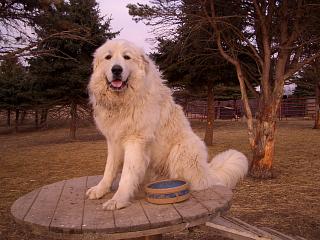
Livestock Guardian Dogs (LGD)--large, aloof, independent breeds such as the Anatolian Shepherd, Kuvaz, Maremma, Burmese Mountain Dog, Komondor and of course, the Great Pyrenees. Unlike herding dogs that depend on livestock's inherent fear of predators, these gentle giants bond with the herd moving effortlessly among the flock.

Many producers choose to keep LGDs to ward off predators such as coyote and mountain lions. More often, as we have, producers employ LGDs to ward off neighbors' domestic dogs that roam free and harass livestock. However, LGDs can do much more than keep the flock safe as I found out yesterday during the morning feeding.

Although we interact with our herd of nearly 50 does daily, close inspection of each animal is not possible. We check for the obvious such as limping, scours, poor condition, etc., but subtle anomalies can be easily overlooked.

Two thirds of the herd is currently bred. After tossing hay, I was walking around the herd checking the girls out when I noticed El Jefe, our Great Pyrenees, was keen on one particular doe. His nose was glued to her hind end as she moved around to get at the hay. Taking a closer look, I realized the young doe had either aborted or was about to abort.

Thanks to my LGD identifying the problem, I was able to bring the doe out of the pasture and into the barn for close monitoring before additional problems, such as possible infection, occurred.

Many producers only factor in the cost savings of livestock protected from predators, however, a good working LGD can alert you to early problems within large herds and flocks, thus saving you even more effort and money in the long run.