Welcome to Painted Hand Farm

Painted Hand Farm is a 20 acre Civil War era farm located in Cumberland county, Pennsylvania. We raise meat goats, veal calves, turkeys and organic vegetables using humane and sustainable agricultural practices.

Search This Blog

Friday, March 23, 2007

Ode to April

She was a big ugly doe with flat, stubby horns protruding from her head instead of the sweeping curved ones indicative of the Boer breed. Her udder was a pendulous spotted bag with an extra nub of a useless teat pointing out of one side. But her pedigree had plenty of heavyweights in the goat world and she was a long tank of doe with good feet and a history for producing triplets.

But today, we had to do the unspeakable, except among those of us who raise livestock, who understand, that sometimes there's just nothing you can do except humanely send a member of the flock to the other side of the rainbow.

Yes, everyone loves to look at all the cute pictures of the goats and their babies, but there's a price we pay for domestication that no one wants to think about.

I breed and raise animals for meat. I know that one day many of my animals will end up on the dinner plate...that's a fact of farming. But when it comes to the death of a working doe, well, that's like losing an old friend.

April will live on in our herd as most of the babies born this season are out of her buck kid from two years ago, HandyMan, who spent a season as our herdsire before going to Clan Stewart Farm in Huntingdon. During her time here at Painted Hand Farm, I longed for a doe kid from April, but she only ever gave me bucks.

A Fresh Way to Start the Morning

Thank you, Miss Cocoa, for a darling pair of does. Usually, we get a 50-50 mix of bucks and does, but this year we're at 75% for doe kids.

Thursday, March 22, 2007

A Double Dose of Does

It's been several days since we've had any new babies, but with the official arrival of spring, kidding season is back in gear. Around noon today, Pumpkin Pie put the fourth generation on the ground with the birth of a solid red doe.

This evening I had a Buy Fresh, Buy Local committee meeting and when I got home Oreo Cookie had just given birth to another doe.

Monday, March 12, 2007

A Pair from Peaches

Good ol' Peaches--the matriarch of the herd and one of the farm's first does--stuck to her routine and birthed a strapping pair of twins during the afternoon warmth. I have no idea of her lineage, but she's a red and white doe who could have a little Spanish, maybe a Saanen and definitely some Boer. But for me, she's an awesome mother who always has multiples in excess of ten pounds each. Her offspring carry the same hardiness. This season, Peach gave us a buck and a doe. The buck is piebald with ears the same shade of light red as his dam's markings while the doe, is Boer correct with a jet black head and blaze on her face. In a day or two, we'll know if they are polled like Peaches. That would be a plus for the buck since he's a contender for one of Jess's 4-H projects, however, I prefer "handles" on all my girls for easier handling.

Sunday, March 11, 2007

Triple Play

On the verge of spring, I thought it best that I get the fruit trees and grape vines pruned and fertilized. While I was working, an enormous flock of Canadian Geese heading north flew over in V formation. Being outside in the sun really charged my batteries.

Closer to lunch time, I checked on the goats to find Ashley in heavy labor. She was ushered into a delivery area where she quickly dropped three bucks. This was perfect because this year when Jessica showed this doe at the Pennsylvania Farm Show, the judge pointed out that she had a "fish teat" which is a cull factor for breeding stock. Granted, as a meat producer I'm not hung up on what I consider minor confirmation defaults in the show ring (fish teats, tail web color, split testicles). I do, however, cull for bad bites, unthriftiness and breeding difficulties. Wanting to always increase the quality of my herd, though, I've decided to not keep any of Ashley's future female offspring for breeding stock. I'll continue to breed her as she is a good mother and has always had multiple births.


Saturday, March 10, 2007

Farming with Free Stuff, Take Three

Frugal, cheap, environmentally conscious--whatever you want to call us, the fact is that we're hopeless dumpster divers who revel finding new life for what others consider useless junk. Living near Shippensburg University, every semester there's always plenty of 'stuff' sitting curbside as students move out. When I saw a couple frat boys carrying a cheap-o metal futon frame to the curb, I whipped right over and told them to just load it on up into the truck.

"Lady, you don't want this. It's broken," one of the boys said.

"That's ok. It's going to be dismantled and turn it into a hay rack," I replied. It never hit the ground.

Ralph is the master when it comes to building useful farm implements out of salvaged materials. So it came as no surprise when he turned the broken futon frame into not one, but two useful items.
The first was a hay rack. The spacing on the frame is perfect for a fence line hay rack.
Not one to turn down free plastic 55-gallon barrels, there is always a few extra stashed away for much needed waterers. So it wasn't a stretch to stabilize two inside the frame ends to keep the goats and calves from rolling them around.
In addition to his practical side, Ralph has a playful nature. I noticed this on the side of the barn the other day. When I asked him about it, he admitted, "I swept the barn floor and that's what I found."

They Actually Listened

The last two nights have been bitterly cold. I mean record-setting lows. So, being practical, I had a talk with all the wide-bodies in the barn just itching to go into labor and kindly asked them not to kid until this arctic blast passes. Call me a nut case, but bless their hearts, those does actually granted my request.

That didn't stop me from checking on them every few hours and keeping my ear glued to the baby monitor all night long these last two nights. But today when the temperature shot up to nearly sixty degrees, Sissy, one of our purebred does, offered up a strapping set of triplets--two does and a buck. The does are both distinctly marked, as you can see. One has a white mustache and the other has a white ear.

Wednesday, March 07, 2007

Lots of Snow & Lots of Babies

We knew with the snow storm someone in the barn would choose to have their babies today. Annabelle, as always, popped out a set of triplets ...three does, no less! While they were all small, one in particular was very small. With the temperature being in the teens and Annabelle preoccupied with the two larger kids, we made the decision to pull the small doe inside and make her a bottle baby for now. The weatherman is forecasting bitter cold for the next two nights and then we should have some warmer temperatures and less worries.

Midnight Delight

I was dead to the world when Ralph walked into the bedroom. "Didn't you hear me on the baby monitor?" he asked standing there in what appeared to be full arctic gear. The receiver crackled next to my head with only static.

Knowing there was a new baby, I shook off what few hours of sleep I had gotten and headed out to the barn.

Nestle had a stout little buck on the ground over which her tongue was moving at lightning speed to get him cleaned off and dry in the bitter cold night. Within minutes of birth, he had found the teat, latched on and his tiny tail wiggled with satisfaction.

Back at the house, I added the birth to the doe's record sheet. "Easy births, good mother, good 'auntie'," I had noted in the margin of her sheet. An 'untie' is the term I use for does who will let any kid nurse off of her.

Another middle-of-the-night check yielded no additions, but with the latest snow storm of the season underway, I'm sure someone will bless us today.

Tuesday, March 06, 2007

Save Your Kids & Your Barn

Yesterday there was another story in the paper about a local farmer's barn burning down. The arsonist...a heat lamp.

Anyone involved in agriculture knows the silver-domed devils we have all used to keep pipes from freezing and newborns warm in the dead of winter.

The last thing I want to see is my 150 year old barn reduced to a pile of ashed over my own stupidity so using unattended heat lamps isn't an option. Unfortunately, it seems like no matter when my does kid, mother nature is in the process of doling out her worst winter smack-down. This year is no different.

But thanks to some handy contraptions that Ralph put together, for less than $10 we can rest easy and keep our kids warm in the barn. Using a plastic barrel (we bought ours for $5 from a guy who salvages them from a local factory that makes ketchup and salad dressings), a porcelain light fixture ($3.99 at the hardware store) and a 100 watt light bulb, our kids stay warm & toasty during the foulest of winter weather. The open end goes on the floor so nothing ever needs cleaned out...just moved. We've seen as many as six kids at a time jigsaw puzzled in to one barrel. Although we chain our barrels to the wall to keep the mommas from knocking them over, even if the barrel were to tip on its side, the bulb would never touch anything to set fire.

A Surprise in the Field

A month before the expected arrival of kidding season, we handle all the exposed does paying close attention to the obvious pregnant girls, but there always seems to be one that fakes us out. Wouldn't you know it, on a bitter cold day where the wind chill hovers in single digits Ralph found a fresh kid in the field when he went out to do the afternoon feeding. At first, he thought it was dead, but when he picked it up the little girl sprang to life. He brought her in the house where I warmed her in a pot of warm water while he went out to bring the momma into the nursery. Despite being chilled, the kid was vigorous and aggressively trying to nurse. Just to be on the safe side, Ralph and I milked a few ounces of colostrum from the momma and bottle fed it to the little doe while drying her off inside. Less than an hour after we found her she was in the barn back with her much relieved momma who was hard at work licking her and coaxing her to nurse.

Sunday, March 04, 2007

Kidding Has Started!

Wouldn't you know it, I leave for a few days to attend the first Pennsylvania Women in Agriculture conference for a few days, Jess is at a 4-H meeting and Clara drops a beautiful set of twins (buck & doe). Ralph was home so he called me in Penn State giving me the blow-by-blow details.

When I got home on Saturday night, Hershey had left us a 'kiss'--a doe. Expect lots more baby pictures this month as the maternity ward here at the farm is quite full of expectant mommas.

Monday, December 25, 2006

Happy Holidays to Everyone

We want to thank everyone who has helped make 2006 a successful year at
Painted Hand Farm.


Friday, December 22, 2006

More than just a Guard Dog

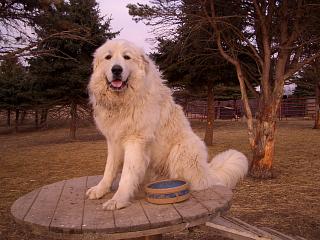
Livestock Guardian Dogs (LGD)--large, aloof, independent breeds such as the Anatolian Shepherd, Kuvaz, Maremma, Burmese Mountain Dog, Komondor and of course, the Great Pyrenees. Unlike herding dogs that depend on livestock's inherent fear of predators, these gentle giants bond with the herd moving effortlessly among the flock.

Many producers choose to keep LGDs to ward off predators such as coyote and mountain lions. More often, as we have, producers employ LGDs to ward off neighbors' domestic dogs that roam free and harass livestock. However, LGDs can do much more than keep the flock safe as I found out yesterday during the morning feeding.

Although we interact with our herd of nearly 50 does daily, close inspection of each animal is not possible. We check for the obvious such as limping, scours, poor condition, etc., but subtle anomalies can be easily overlooked.

Two thirds of the herd is currently bred. After tossing hay, I was walking around the herd checking the girls out when I noticed El Jefe, our Great Pyrenees, was keen on one particular doe. His nose was glued to her hind end as she moved around to get at the hay. Taking a closer look, I realized the young doe had either aborted or was about to abort.

Thanks to my LGD identifying the problem, I was able to bring the doe out of the pasture and into the barn for close monitoring before additional problems, such as possible infection, occurred.

Many producers only factor in the cost savings of livestock protected from predators, however, a good working LGD can alert you to early problems within large herds and flocks, thus saving you even more effort and money in the long run.

Sunday, November 12, 2006

Fall Fare

I love fall. Maybe I should clarify that statement. I love eating in the fall. The early frosts bring out the sweetness in the chards, kales and brussel sprouts. The vines on the all the potatoes die back signalling their readiness to be dug from the earth softened by autumn rains.

Digging veggies liberates that earthy aroma--the familiar fragrance mixed of mineral, decaying organic material and the vegetables themselves. I love the way the dirt clings to my fingers as I snap the sun chokes off the root ball that once supported sunflower-like stems towering over six feet. "Choke" is an appropriate name for them since they literally choke out everything in the surrounding area. Right now the horseradish is fighting for its patch in the perenial garden and the noduled tubers are encroaching into the herbal district.

Another aspect of fall is with the cooler weather comes butcher time. A few weeks ago, we had to slaughter a goat for roasting at a picnic so at the same time, we did a lamb for the freezer. Ralph was going out of town, Jessica was going to a friend's for the weekend so I vacuume-packed all of it until tonight.

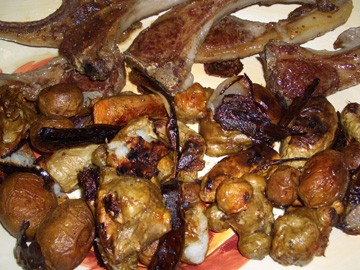
It feels really good knowing that only an hour earlier the roasted sweet potatoes and russets, sun chokes, onions and carrots on our dinner plates were still snug in the garden and the lamb chops led a bucolic life in pasture prior to a quick and humane dispatch. I rest easier knowing that lamb was slaughtered and packaged in a clean environment...my backyard and my kitchen. My vegetables have been fertilized with rich compost made from the manure of grass-fed animals...no O157 E. coli on my salad greens.

Raising healthful, natural and safe food for ourself and others is a lot of hard work, but when I am able to sit down to a meal, such as tonight's, it puts a season of our labors into perspective.

Tuesday, November 07, 2006

Farming with Free Stuff Revisited


It's one thing to salvage things like sheds, vehicles, tools, etc., but the opportunity recently presented itself for a roadside salvage operation for some premium hay.
"Sandy, someone dropped a large bale of nice hay down the road from your place," said the voice of my ususal hay man on my answering machine, "It's laying right along side the road." With over a hundred mouths to feed on the farm, this warranted a closer look so I grabbed a pitchfork and corralled my daughter into going along.
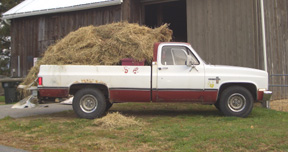
Sure enough, there was a very large bale of number one hay pushed off the road on a curve. It was hay auction day, so my guess is one of the local farmers took the curve a bit too fast and the bale fell off breaking open. I positioned the truck on the downhill as close to the hay as I could get and began loading it on the truck.
"Mom, this is so embarassing. What if someone from school sees us?" my daughter wailed.
"Tell them that because I got $50 of free hay, I can spend that on clothes for you," I shot back and then went on to ask her how much the dress was I had purchased for her a few weeks before.
"There's no way you're going to fit all of this on the truck," she countered.
"Watch me." For the next fifteen minutes we proceeded to stack all of the 750 pound bale on the truck. She needled me again.
"We'll never get it all home." In response, the truck never reached 10mph on the trip up the street. Not only did I get the entire bale on the truck, I made it home without losing any.
The next day I got a call from one of the other local farmers from whom I often purchase hay.
"You must be really in need of hay if you have to pick up what I've dropped along side the road," he joked. Actually, he admitted to yes, as I suspected, taking the curve too fast on his way to the hay auction and losing, not one, but six large bales off his truck. Fortunate for him, only one broke open.
Since he was scheduling a delivery I offered to pay him for the bale. "Nah, that was close to an 800-pound bale. If you picked it up, you earned it," he said.
So for 15 minutes of exercise, I made off with $50 of premium hay. Not too shabby.

Thursday, November 02, 2006

Gobble Gobble


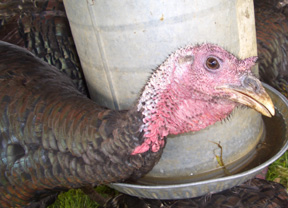
I raise a flock of Heritage turkeys on pasture each year because I like the taste of grass-fed poultry and I want to make sure the bird that graces my holiday table hasn't been stuffed in some fetid commercial poultry house breathing fecal fumes and been subjected to the mutilation of having its beak and toes chopped off to prevent the cannibalism that is commonplace in overpopulated poultry operations. The first year we moved to the farm in Pennsylvania, we bought poults from a local Mennonite family with a large turkey operation. They only had half a top beak and the scarred toes left alien prints in the dirt as their toes looked more like geko feet than that of a turkey.

So what's the big difference between a Heritage and a Commercial turkey is the most common question I'm asked and I always answer breasts & sex. Modern birds are the Dolly Partons of the turkey world. They've been selectively bred to grow gargantuan pectorals to please consumers. Unfortunately, at the same time, they've bred the ability for these top-heavy gobblers to reproduce naturally. We allowed four of our Mennonite-mutilated birds to reach adulthood--three hens and a tom. When spring came, the hens lined up ready to be services but the poor ol' tom could only give them some "wing". With his enormous chest, his tiny pecker (and I'm not talking about the half a pecker on his face) couldn't come close to hitting the mark. So we ate the turkey eggs along with the turkeys eventually.

Which leads me to the next most common question--how can you eat your turkeys? That's easy. Anyone who has ever raised turkeys will tell you that by the first of November they start chanting, "Three more weeks! Three more weeks!" I move two dozen birds in a portable house two to three times a day and by now the amount of crap they leave behind will gag even the strong of stomach. I can only imagine what thousands of these critters confined by the thousands in an enclosed building must be like.

I've also read enough USDA butchering regulations to know that the reason the health department suggests you incinerate a turkey to 180 degrees internal temperature is because of all the unsanitary conditions when the birds are processed. When anyone eats one of my birds, I've personally cleaned it and know that the intestinal tract hasn't been broken open by automated cleaning equipment thus contaminating the carcass with fecal matter--the source for pathogens that make people sick.

But there is one thing about my Heritage turkeys that I do love (beside the taste). There's something ethereal about stepping outside on a crisp autumn morning and hearing turkeys. They chirp and tribble some while young, but the familar gobbling doesn't begin until mid-October when the first frost appears against the backdrop of flame-colored leaves signalling fall.


Tuesday, September 05, 2006

5th Annual Labor Day Goat Roast

Yes folks, we survived yet another goat roast here on the farm. Over sixty of our family and friends turned out to wind down summer and share the fruits, vegetables, meats and dairy products of our labors. That's Ian Dietrich and Mark Cochran slicing up the roasted goat. There was also BBQ pulled pork and smoked turkey for those not brave enough to partake in the most widely-consumed meat on this planet. Believe it or not, more people eat goat meat than beef, pork, fish, poultry and game.

This year we went island-style instead of Mexican. The goat was rubbed with Jamaican jerk spiced, stuffed with chunks of fresh pineapple, papaya, oranges and cilantro and roasted on a spit over hot coals while basted with crushe pineapple, orange juice, crushed garlic and olive oil. The result was stunning. Out of a 40-pound goat, we had a one-quart container of leftovers.


The assortment of goodies laid out on the buffet table was overwhelming, but my all-time favorite is the home-made ice cream. For the last few years, we always did fresh peach with goat's milk, but sadly this year our wonderful milk goat, Liberty passed away. Breaking from tradition, I procured a few gallons of very fresh, whole Jersey milk. First, I let the luscious thick cream float to the top and then skimmed it for later use. The 'skimmed' milk was mixed with fresh pastured poultry eggs and turned into a custard. When the time was right, I put the custard, fresh cream and a thick syrup made from reduced wild black rasperberry juice and sugar all into a White Mountain Ice Cream Maker and plugged it in. In 20 minutes, we were treated to the most incredible, berry-flavored, silky home made ice cream I've ever done. I made sure everyone got a scoop, but I got my favorite part--to lick off the beaters!

As requested by several folks, here is the ice cream recipe.

Wild Black Raspberry Ice Cream

1/2 gallon whole milk (use creamline if you can get it)
1 pint fresh cream
4 large fresh eggs
1/2 vanilla bean, scraped
2 cups raw sugar
1 pound black raspberries

Custard
Beat 1 cup milk and eggs on high until fully mixed and frothy. Put into a heavy-bottomed pot with the remaining milk, 1 cup sugar and vanilla bean scrapings. Slowing bring to a light boil while whisking constantly. Cook 3-5 minutes until it starts to thicken. Remove from heat and continue to stir for 3-5 minutes. Let cool further, transfer to container and refridgerate.

Berry Syrup
Puree berries in a food processor until mushy. Drain in cheese cloth so there is only juice--no seeds. Squeeze as much juice as possible and discard solids. Tranfer juice to sauce pan and reduce by 1/3. Add sugar, bring to a boil for 2-3 minutes. Cool and refridgerate.

Making the Ice Cream
In a six-quart ice cream maker, put in custard, berry syrup and cream and make according to manufacturers' instructions.


Friday, September 01, 2006

It's raining....

Ok, so I rarely post. Think of it as a mechanic whose car needs fixed, a plumber with a stopped up toilet, a seamstress with hems too long, a hair stylist who needs her roots covered....you get the picture. But here I sit with Ernesto bearing down on us, a chicken in the oven, okra waiting to be fried and me killing time until Jess gets home from work. Ralph is happy on the couch with all the pets camped out on top of him.

As the rain finally arrives after a most dry summer, I thought I'd share the latest of farm gadgets (pardon the lack of pictures). After five years, we finally had rain gutters installed on the barn. Not wanting to squander all that wonderful rain we had been dancing for, we plumbed the downspouts into a stock tank to capture the runoff. Our 100-gallon Rubbermaid said idle for several weeks until we were blessed with 3/10th of an inch of rain last week. Starting out dry, the tank was millimeters from overflowing when the rain stopped. So we can officially say that 3/10" rain on half our barn roof yields 100 gallons.

Recently I was awarded a Project Grass Grant to increase the fencing on my farm for rotational grazing and the big question was how I was going to provide water to my stock. So I put Ralph to work with his creative ways. For those of you who remember the stories of the fish boxes, they are having yet another iteration. He plumbed the 100-gallon tank at the barn with a ball-valve leading into a collapsable irrigation pipe (which he had to encase in PVC & drainage pipe to keep the more gregarious critters from playing with it) and down over the hill (gravity feed) into the famous fish box. If you've ever watched any of the newer Star Trek series, you'll recognize them as a staples of the cargo decks. They are 300-gallon poly-boxes that can be picked up with a fork-lift and they have flat lids that snap on so they can be stacked.

This particular fish box had functioned as our quasi-hot tub for many years out west (and for a while here) before being plumbed up for a water storage tank.

We've had about a half inch so far and the system is working well. Water falls from the sky, hits the barn roof, is gathered by the gutter and directed downspout to the 100 gallon tank. When it reaches capacity, water then flows through the irrigation pipe approximately 300 feet down hill to the fish box tank where it has a hose fitting to supply water to assorted water barrels for the goaty girls.

And when Mother Nature doesn't deliver, there is always the well.

Sunday, April 02, 2006

BEEF--It's what's in the barnyard.


Last week when I was driving back from Penn State with a fellow farming friend who owns a dairy, I asked about getting a bull calf to raise up as a beef steer.

"Oh please! How many do you want? I'm overrun with bull calves right now," she said.

The possibility of plural sent warning bells since the only time we acquire more than two of anything at a single time on the farm is with fowl.

With that thought passing through my mind I replied, "One or two would be fine."

"How about three," she countered.

"Sure. I'll pick them up on Saturday." What had I gotten myself into?

Saturday rolled around and when I went to pick up the calves, there was Mel's husband with halters on FOUR calves.

"Four calves?" I asked.

"Mel said you were to get four," he replied. Looking over at her calf hutches, I saw why. There was no room left at the inn and some pens were doubled up with smaller calves.

So home I went with four bull calves.

Now many people who raise animals for meat don't name them, but my philosophy has always been to know the name of everything in my freezer. I know where it came from, how it was raised, how it was slaughtered and that it hasn't been pumped full of antibiotics, synthetic estrogen (growth hormones) and carbon monoxide to keep it looking fresh well after it has rotted.

Meet Pinky, Blacky (the colors of their tongues), Blondy and Dameon (he was born on 6-6-06).

Oh sure, feeding cute calves with a bottle...right? I DARE anyone to walk into a group of hungry calves with one bottle. They may be babies, but they are 100 pound babies with these tiny nubs growing out of their skulls that leave colorful bruises on your legs when they butt you with their heads (common action used to massage the cow's udder to stimulate milk let down). They may only have teeth on their bottom jaw, but they will still take the skin off your knuckles when they try to suck on your fingers thinking they're going to get something. And if you're not paying attention and your clothing gets chewed on (they have teeth in the back) it can be literally shredded in a matter of minutes.

So the next step was to put together something called a "mommy bucket". Two buckets with two teats each for four calves worked like a charm.